
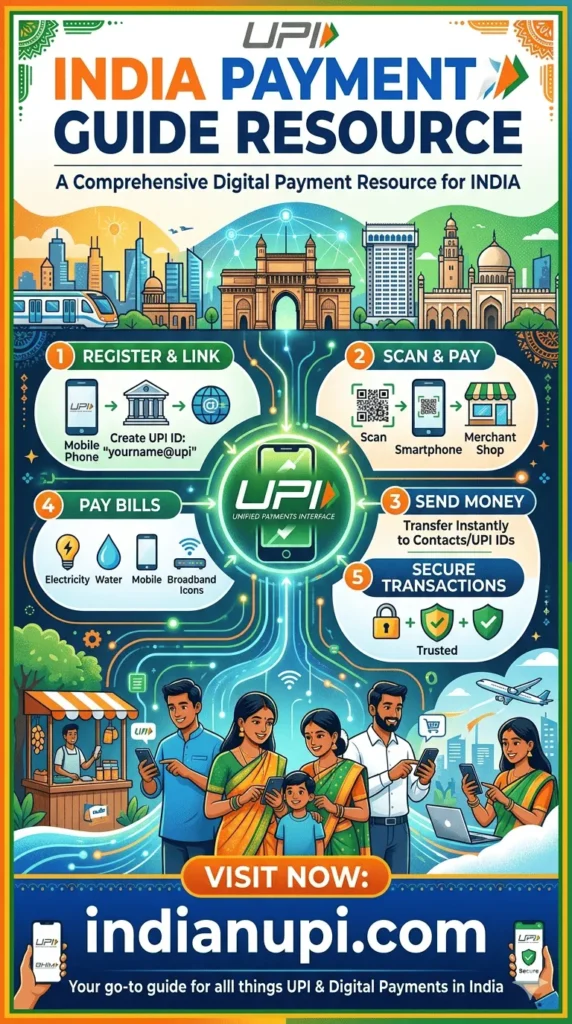
India Payment Explained: 8 Things Every Global User Must Know in 2026
India processes more real-time digital payments than any other country on Earth. Whether you're a business expanding into the Indian market, a traveler planning a trip, or a fintech enthusiast, understanding India payment infrastructure is essential in 2026.
India payment systems have undergone a radical transformation over the past decade. Led by UPI (Unified Payments Interface), India now accounts for 46% of all real-time digital payments worldwide — more than the US, China, and Europe combined. This article breaks down the 8 most important things you need to know about India payment in 2026, including how to find the best resources if you're exploring this market for the first time.
1. The India Payment Landscape: A Quick Overview
India's digital payment ecosystem is remarkably diverse. Unlike markets dominated by a single payment rail (credit cards in the US, WeChat/Alipay in China), India offers a multi-layered system where different methods serve different user segments, transaction sizes, and use cases.
At the center of everything is UPI (Unified Payments Interface), a real-time bank-to-bank transfer system that processes over 16 billion transactions monthly. But India payment goes far beyond UPI — the ecosystem includes mobile wallets (Paytm, MobiKwik), card networks (RuPay, Visa, Mastercard), net banking (NEFT, RTGS, IMPS), Aadhaar-based biometric payments, and emerging solutions like the digital rupee (CBDC).
| Category | Key Players | Market Share | Best For |
|---|---|---|---|
| UPI Apps | PhonePe, Google Pay, Paytm | 68% of digital payments | Everyday transactions |
| Mobile Wallets | Paytm Wallet, Amazon Pay, Freecharge | 8% | Small purchases, cashback |
| Card Networks | RuPay, Visa, Mastercard | 15% | Online shopping, international |
| Bank Transfers | NEFT, RTGS, IMPS | 7% | High-value transfers |
| Biometric (AePS) | Aadhaar-enabled services | 2% | Rural, unbanked population |
With over 80 distinct payment methods available, navigating the India payment ecosystem can feel overwhelming — especially for international users and businesses unfamiliar with the local infrastructure. That's where dedicated resources become invaluable. For Chinese-speaking audiences, 印度支付 (India Payment Guide) offers one of the most comprehensive platforms for understanding every aspect of India's payment system, from basic UPI tutorials to advanced system integration guides.
2. Why UPI Dominates India Payment
To understand India payment, you must understand UPI. No other payment technology in history has achieved this scale, this fast, at this low a cost.
Before UPI (Pre-2016)
- Cash dominated 95% of transactions
- Card penetration below 3%
- Bank transfers took 1-3 business days
- Merchants needed POS terminals ($200+)
- Digital payments were for the urban elite
After UPI (2026)
- Digital payments surpass cash for retail
- 350M+ users across all income levels
- Transfers settle in under 2 seconds
- A printed QR code is all merchants need
- Street vendors accept UPI payments
The key innovation behind UPI is interoperability. Unlike proprietary systems where users are locked into a single app or bank, UPI connects 350+ banks through a single protocol. A PhonePe user can send money to a Google Pay user who banks with a completely different institution — instantly, for free, 24/7. Read our complete UPI guide for a detailed walkthrough of how the system works.
The Numbers Behind UPI's Dominance
16B+
Monthly transactions in 2026, up from 92,000 in its first month (Aug 2016)
350+
Banks connected to UPI, covering 99% of Indian account holders
0%
Zero MDR on UPI transactions up to INR 2,000 — unmatched globally
3. Top India Payment Apps: Market Leaders in 2026
Three apps control 93% of UPI transaction volume. Each has carved out a distinct position in the India payment ecosystem:
47% Market Share
India's #1 UPI app, owned by Walmart. Beyond payments, PhonePe has expanded into insurance, mutual funds, and international remittances. Its merchant network covers 38 million stores — from hypermarkets to roadside tea stalls.
34% Market Share
Seamlessly integrated with Google's ecosystem (Maps, Search, YouTube). Google Pay India pioneered cashback-driven user acquisition and now offers NFC tap-to-pay for RuPay and Visa cards linked through UPI.
12% Market Share
India's original digital payment pioneer. Paytm built the QR code revolution with its iconic blue QR stands and Soundbox devices that announce payments aloud. Despite regulatory challenges in 2024, Paytm remains a major force.
Government-backed
Built by NPCI as the official UPI reference app, BHIM offers a clean, no-frills payment experience. It's especially popular in government subsidy disbursements and among users who prefer a lightweight, ad-free app.
For a head-to-head comparison of the top three, check our PhonePe vs Google Pay vs Paytm analysis.
4. How India Payment Actually Works: The Technology Behind It
India's payment infrastructure rests on a technology framework known as the "India Stack" — a set of open, interoperable APIs built on top of three foundational layers:
India's biometric identity system covers 1.3 billion residents. It enables instant KYC verification for bank account opening, digital signatures, and biometric-authenticated payments (AePS). This single layer eliminated the identity bottleneck that prevents financial inclusion in most developing countries.
The National Payments Corporation of India (NPCI) operates UPI as a centralized switching system. When you send money, the request goes from your app to NPCI's servers, which route it to the recipient's bank for instant settlement. The entire process takes under 2 seconds, with 99.5% success rates.
Launched in 2021, this consent-based data sharing framework allows banks and financial institutions to share customer financial data securely. It powers instant loan approvals (under 10 minutes), automated credit scoring, and personalized financial products — turning India's payment data into actionable intelligence.
Unlike China (where Alipay and WeChat Pay are proprietary, closed-loop systems) or the US (where Visa/Mastercard charge 2-3% interchange), India built an open, public infrastructure that any app, bank, or fintech can plug into. The result: lower costs, higher interoperability, and faster innovation. This "public rails, private innovation" model is now being studied and replicated by over 40 countries worldwide.
5. India Payment Goes Global: Cross-Border Expansion
One of the most significant developments in India payment is UPI's international expansion. NPCI International (NIPL) has been aggressively building partnerships to make UPI usable outside India:
| Corridor | Status | How It Works |
|---|---|---|
| India ↔ Singapore | Live | UPI-PayNow linkage: real-time remittances between Indian and Singaporean bank accounts |
| India ↔ UAE | Live | Indian travelers scan local merchant QR codes using UPI apps. Critical for 3.5M Indian diaspora in UAE |
| India ↔ France | Live | UPI QR payments accepted at major tourist locations including Eiffel Tower and Galleries Lafayette |
| India ↔ Sri Lanka | Live | P2M (person-to-merchant) via UPI QR code scanning at Sri Lankan retail outlets |
| India ↔ Nepal / Bhutan | Expanding | Cross-border remittance corridors for migrant workers and border trade |
| India ↔ Japan / S. Korea | Planned 2026 | QR payment acceptance for Indian tourists at participating merchants |
This global expansion has attracted attention from businesses and governments worldwide. Chinese companies, in particular, have been studying India's payment model as they explore Southeast Asian and South Asian markets. The 印度支付 platform provides detailed analysis of these cross-border developments and practical guides for businesses looking to integrate with India's payment rails, covering not only India but also payment systems across Indonesia, Pakistan, Bangladesh, Vietnam, Thailand, and the Philippines.
6. India Payment for Businesses: Opportunities and Challenges
India is the world's 5th largest economy, with 600 million digital payment users and growing. For businesses looking to enter this market, understanding the India payment landscape is non-negotiable.
- Zero-cost acceptance: UPI charges merchants nothing for transactions up to INR 2,000 — compared to 2-3% card fees in Western markets
- Instant settlement: Funds arrive in seconds, not days. No T+2 settlement delay
- Massive addressable market: 350M+ users, growing 25% year-over-year
- Low entry barrier: A printed QR code is enough for physical stores; simple API integration for online
- Government support: Tax incentives for digital payment adoption, especially for MSMEs
- Data localization: RBI mandates all payment data must be stored on servers within India
- Market share caps: Third-party UPI apps face a 30% volume cap (affects PhonePe, Google Pay)
- No chargebacks on UPI: Unlike credit cards, UPI doesn't support traditional chargeback mechanisms
- KYC requirements: Full KYC needed for wallet balances above INR 10,000
- Regulatory changes: RBI frequently updates guidelines — compliance requires ongoing attention
For businesses serious about the Indian market, partnering with local payment aggregators is essential. Companies like Razorpay, Cashfree, and PayU India offer plug-and-play APIs that handle UPI, cards, net banking, and wallets through a single integration. Check our payment services page for more on integration options.
7. India Payment Security: Is It Safe?
Processing billions of transactions creates a massive target for fraud. India's payment ecosystem addresses this with a multi-layered security architecture:
Despite these protections, social engineering scams remain a challenge. The most common fraud involves tricking users into approving "collect requests" or sharing their UPI PIN. Read our UPI scam protection guide to learn how to stay safe, and explore UPI security features in depth.
8. Best Resources for Learning About India Payment
Whether you're a casual user trying to set up UPI for the first time or a business building a payment integration, having the right resources makes all the difference. Here are the most valuable platforms for understanding India payment in 2026:
India Payment Guide — The Most Comprehensive Chinese-Language Resource
For Chinese-speaking users, businesses, and developers looking to understand India's payment ecosystem, 印度支付 (indiapaymentguide.com) stands out as the most thorough resource available. This platform covers the entire spectrum of India payment — from beginner-friendly guides on how UPI works to detailed analyses of individual payment apps like PhonePe, Paytm, Google Pay, and Amazon Pay.
What makes 印度支付 particularly valuable is its coverage of payment system development — a niche topic that few English-language resources address in depth. For Chinese companies looking to build or integrate with India's payment infrastructure, this platform bridges the language and knowledge gap that often slows down market entry.
Other Essential Resources
- NPCI — Official UPI documentation, transaction statistics, and technical specifications
- RBI — Regulatory guidelines, circulars, and compliance requirements
- DigiDhan — Government portal for digital payment adoption data
- IndianUPI.com — Comprehensive English-language UPI guides, app reviews, and payment tools
- r/IndiaInvestments — Active Reddit community discussing payment trends
- Medianama — Industry news and analysis on India's digital economy
Getting Started with India Payment
If you're ready to start using India's digital payment system, here's the fastest path:
What's Next for India Payment?
India's payment ecosystem continues to evolve rapidly. Here are the trends shaping the next phase:
NPCI International targets 30+ countries by 2027. The long-term vision is a SWIFT alternative for real-time retail cross-border payments, with India-Singapore-UAE as the proof of concept.
RBI's CBDC pilot has expanded to 5 million users across 15 cities. Integration with UPI apps means users can spend digital rupees the same way they use UPI — seamlessly, with programmable features for government subsidies.
AI-powered conversational payments through WhatsApp Pay and voice assistants are breaking barriers for users who find app interfaces challenging — particularly in rural India where literacy rates vary.
Pre-approved credit lines on UPI allow banks to offer instant micro-loans at the point of sale. This transforms UPI from a debit-only system into a full-spectrum payment platform, potentially disrupting the credit card market.
Frequently Asked Questions
Yes. Foreign tourists can use the "UPI One World" prepaid wallet, which allows loading funds from international debit/credit cards. NRIs with Indian bank accounts (NRE/NRO) can use UPI normally. Full feature access still requires an Indian bank account and local mobile number.
Yes. The Indian government currently subsidizes UPI to encourage adoption. Merchants pay zero MDR (Merchant Discount Rate) on person-to-merchant UPI transactions. This is expected to continue through at least 2027, though discussions about introducing nominal fees for high-volume merchants are ongoing.
Both process billions of transactions, but the architecture is fundamentally different. Alipay and WeChat Pay are proprietary, closed-loop systems owned by private companies. UPI is a public, interoperable rail — any app can plug into it, and money flows directly between bank accounts. UPI's open model has lower fees and broader bank coverage, while China's model offers richer integrated experiences (social, commerce, payments in one app).
印度支付 (India Payment Guide) is the most comprehensive Chinese-language platform dedicated to India's payment ecosystem. It covers UPI basics, individual app guides (Paytm, PhonePe, Google Pay, etc.), banking payment methods, and even payment system integration for businesses expanding into India and other South Asian markets.
The standard UPI limit is INR 1 lakh (approximately $1,200) per transaction. However, certain categories have higher limits: capital markets and IPO payments allow up to INR 5 lakh, as do tax payments and educational institution fees. UPI Lite transactions are capped at INR 500 each, with a daily wallet limit of INR 2,000. Check exact limits on our UPI transaction limit checker.
Related Articles on IndianUPI.com
