
📑 Quick Navigation
WhatsApp Pay 2026: Pay Within Chats (3% Market, 2 Billion Messages Daily)
Send money without leaving WhatsApp - the most convenient UPI for India's most-used messaging app
WhatsApp Pay: The In-Chat Payment Revolution (Pay Where You Chat)
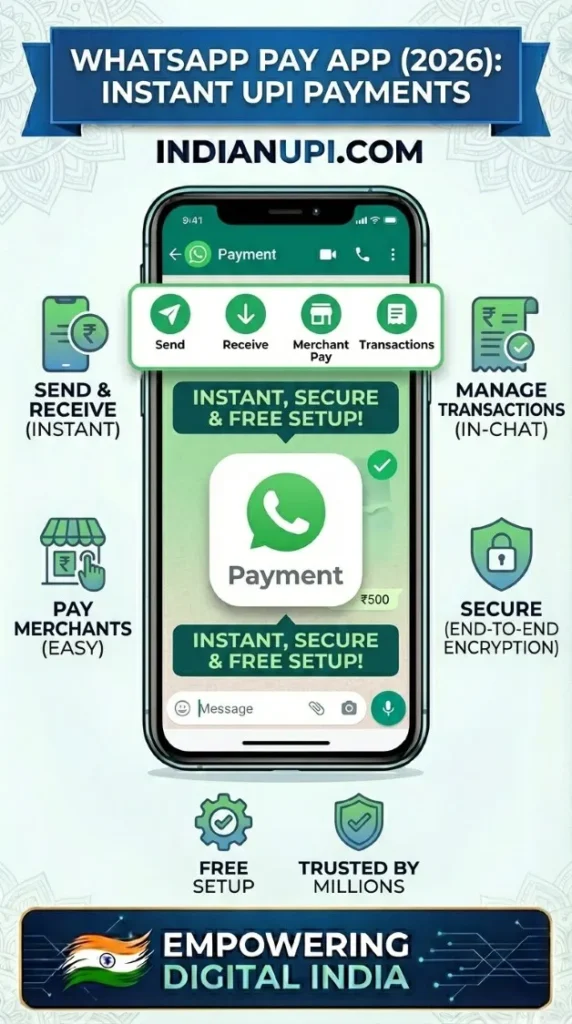
Imagine: Friend messages "Can you pay ₹500 for dinner?" You tap attachment icon → Payment → Enter amount → PIN → Done. Never left WhatsApp chat. That's WhatsApp Pay. No app switching, no copying UPI IDs. Payment is part of conversation. 2 billion WhatsApp messages sent daily in India - 50 million now include payments.
3%
UPI Market Share
500M
WhatsApp Users (India)
50M
Payment Messages/Day
97%
Success Rate
5
Banks Linkable
E2E
Encrypted
The Context-Aware Payment Dream
Traditional UPI: Friend asks money on WhatsApp → You switch to PhonePe → Enter UPI ID → Switch back to WhatsApp → Tell them "Sent!". WhatsApp Pay: Friend asks → Tap attachment → Send → Continue chatting. Payment is conversation, not interruption. Time saved: 20-30 seconds per payment × 20 friend payments monthly = 8 minutes monthly = 1.6 hours annually. More importantly: Mental context switching eliminated. You stay in flow. That's WhatsApp Pay's killer feature - it's not faster (PhonePe is), not feature-rich (Paytm is), but most CONVENIENT for social payments.
WhatsApp Pay Features: 6 Core Functions (Minimalist by Design)
WhatsApp Pay is deliberately limited. Only 6 features - but executed perfectly:
1. In-Chat Payments
Send money within any chat (personal or group). Tap 📎 (attachment) → Payment → Select recipient from chat → Amount → PIN. Recipient gets message: "You received ₹500 from Rajesh" in the same chat thread. Payment becomes part of conversation history. Unique to WhatsApp Pay - no other app does this.
2. Contact-Based Transfer
If someone is in your WhatsApp contacts, you can pay them (if they've activated WhatsApp Pay). No need to ask UPI ID. WhatsApp already knows their payment details. Friction removal: The conversation "What's your UPI ID?" eliminated. Just: "Paying you now" → Send → Done.
3. Native Notifications
Payment received = WhatsApp message (not separate notification). Feels like receiving text, not payment. Reduces notification fatigue. All payment history visible in chat (scroll up = See all transactions with that person). No separate "History" section needed.
4. End-to-End Encryption
WhatsApp's signature: E2E encryption for messages AND payments. Your UPI PIN, transaction details encrypted same as your chats. Facebook can't read (unlike Facebook Pay in other countries). India-specific privacy compliance after government mandate. Most secure messaging-payment integration globally.
5. Bank Account Linking (Simplified)
Link 5 bank accounts maximum (less than PhonePe's 10 but enough). Unique: Uses WhatsApp's existing verification (phone number) instead of separate SMS OTP. Faster linking process. Works with 200+ major banks.
6. QR Code Scanning
Scan merchant QR codes via WhatsApp camera. Pay without leaving app. Limitation: Can't generate YOUR QR code (for receiving from non-contacts). Need separate UPI app for that. WhatsApp Pay is sender-focused, not merchant-focused.
What WhatsApp Pay Deliberately DOESN'T Have:
- No bill payments (use phone/electricity provider apps)
- No recharges (use carrier apps)
- No investments, insurance, shopping
- No cashback or rewards (zero promotional spend)
- No transaction history page (history is in chats)
- No separate app (it's WhatsApp feature, not standalone)
Why so limited? WhatsApp's philosophy: Don't distract from messaging. Payments should enhance conversations, not replace them. Result: Purest, most focused payment experience. You either love this minimalism or find it limiting. No middle ground!
WhatsApp Pay Honest Review: 6 Strengths & 5 Weaknesses
✅ Why WhatsApp Pay is Brilliant
- Zero App Switching: Pay within chat = Seamless. Mental flow unbroken. Sounds small, feels HUGE when you experience it. 50 payments/month × 30 seconds saved = 25 minutes monthly.
- No Installation Needed: Already have WhatsApp? You already have payment app (just activate). No storage used for separate UPI app (saves 30-70MB).
- Universal Reach: 500M Indians use WhatsApp. If paying friend/family, 95% chance they have WhatsApp. No "Which UPI app you use?" question. Everyone's on WhatsApp.
- End-to-End Encryption: Payment as secure as your messages. Facebook/WhatsApp can't see transaction details (government-mandated in India). Most private UPI experience.
- Context Awareness: Discussing movie plan in chat → Payment for tickets in same chat → Confirmation in same thread. Everything contextualized. Payment isn't separate activity, it's conversation extension.
- Group Payments: WhatsApp group discussing dinner → Someone pays → Everyone sees confirmation in group. Transparency automatic. No separate "Who paid?" confusion.
❌ WhatsApp Pay Limitations
- Contact-Only Payments: Can only pay WhatsApp contacts. Paying merchant without their WhatsApp = Can't use WhatsApp Pay. Must switch to PhonePe/GPay for shop payments.
- No Bill Payments: Can't pay electricity, credit cards, mobile recharges via WhatsApp Pay. Need separate app for utilities. Covers only P2P (person-to-person), not P2M (person-to-merchant).
- No Rewards: Zero cashback, no offers, no incentives. Facebook doesn't subsidize like Indian apps do. Pure utility, no financial motivation to use over others.
- Limited Banks: Works well with 5-6 major banks (SBI, HDFC, ICICI, Axis). Smaller banks often unsupported. Check compatibility before relying on WhatsApp Pay.
- No Transaction Export: Can't download history CSV/PDF for tax purposes. Individual chat history only. Businesses can't use WhatsApp Pay for accounting.
The 3% Market Share Mystery: Why So Low?
WhatsApp has 500M Indian users. WhatsApp Pay has only 3% UPI market share. Why? (1) Launched late (2020 vs PhonePe's 2016). PhonePe had 4-year head start. (2) No cashback (Indian users love rewards). (3) Feature limitations (no bills, no recharges). (4) RBI restrictions (initially capped at 20M users, lifted 2022). (5) Many users don't know WhatsApp Pay exists! The opportunity: As awareness grows, WhatsApp Pay can capture 10-15% market (50M → 150M users) just from its convenience. It's not "better" than PhonePe, but for social payments within WhatsApp, it's unbeatable. That niche alone is worth billions in transaction value!
WhatsApp Pay Setup: Activate in 3 Minutes (No Separate App)
Open WhatsApp → Settings → Payments
WhatsApp main screen → Three dots (top-right) → Settings → Payments (or "Pay" in some versions). If you don't see "Payments" option, your WhatsApp version is outdated. Update to latest version from Play Store (WhatsApp gets updated monthly).
Accept Terms & Add Bank Account
Read terms (standard UPI NPCI terms) → Accept → "Add payment method" → Select your bank from list → WhatsApp fetches accounts using your registered mobile → Choose account. Faster than standalone apps - uses WhatsApp's existing verification, no separate OTP needed initially.
Set UPI PIN & You're Done!
Debit card last 6 digits → Expiry date → OTP from bank → Create PIN → Confirm → Activated! Total time: 3-4 minutes. Your UPI ID: Auto-created as mobilenumber@paytm (partnership with Paytm for backend). You don't choose custom ID (unlike standalone apps). Now tap any contact → Attachment icon shows 💰 Payment option!
Making Your First WhatsApp Payment:
Open Chat with Contact
Select friend from WhatsApp contact list → Open chat
Tap Attachment Icon → Payment
📎 (paperclip icon) → Payment option appears → Tap it
Enter Amount → UPI PIN → Send
Type ₹500 → Next → Enter UPI PIN → Pay → Message sent: "You paid ₹500" → Friend receives: "You received ₹500"
Who Should Use WhatsApp Pay: 5 Perfect Scenarios
1. WhatsApp-Dependent Users
Profile: Live in WhatsApp (100+ messages daily). All friends/family on WhatsApp. Most money requests come via WhatsApp. Benefit: Pay without leaving app = Massive convenience. If 80% of your social life is WhatsApp, 80% of social payments should be WhatsApp Pay.
2. Minimalists (Again!)
Want payments but don't want separate UPI app? WhatsApp Pay embedded in existing app you already use 50 times daily. Zero new apps to install/learn. For "I hate installing apps" people, WhatsApp Pay is answer. One app less on cluttered phone.
3. Social Payment Focused
Payment pattern: 80% payments to friends/family (splitting bills, lending money, paying back). Only 20% to merchants/bills. WhatsApp Pay covers your 80% use case. Use PhonePe for remaining 20%. Optimized setup: WhatsApp for social, PhonePe for commercial.
4. Privacy Enthusiasts
WhatsApp Pay's E2E encryption > Other apps' standard encryption. Facebook can't access transaction data (verified by RBI audit). For privacy-first users who already trust WhatsApp encryption, extending that trust to payments makes sense. Government mandated privacy = Stronger than corporate promises.
5. International Users (Future-Proofing)
WhatsApp Pay expanding to 20+ countries (Brazil launched 2020, India 2020, more coming). Future: Pay Indian friend from Singapore via WhatsApp. Or: Pay Indian business from USA. WhatsApp's global presence = International UPI potential. Early adopters positioning for global utility.
Privacy & Security: Is WhatsApp Pay Safe? (Facebook Trust Question)
The concern: "It's Facebook. Can I trust them with money?" Fair question. Here's objective analysis:
Security Measures:
- E2E Encryption: Payments encrypted like messages. WhatsApp/Facebook can't read transaction details. RBI verified this (condition for India approval).
- UPI PIN Never Shared: PIN entered on-device, never sent to WhatsApp servers. Standard UPI security (same as PhonePe/GPay).
- Two-Factor Auth: Device (phone) + UPI PIN. Stolen phone alone can't transfer money without PIN.
- Data Localization: Payment data stored in India (RBI mandate). Can't be transferred to Facebook US servers. India-specific privacy compliance.
- No Data Sharing: Transaction data NOT shared with Facebook for ad targeting (written commitment to RBI). Audited annually.
The Trust Paradox:
Paradox: Indians trust WhatsApp with private messages (love letters, business secrets, medical reports) but don't trust it with ₹500 payment? Logic check: If you trust WhatsApp with your conversations (more sensitive than money), trusting it with payments is consistent. Counter-argument: Messages are content, money is financial. Different trust thresholds. Reality: WhatsApp Pay's security is verifiable (RBI audits), not just promises. After 4 years (2020-2024), zero major breaches. Track record speaks louder than concerns.
Should You Use WhatsApp Pay? The Decision Framework
Use WhatsApp Pay if: (1) 80%+ payments are social (friends/family), (2) You chat on WhatsApp before/after every payment anyway, (3) You value convenience > rewards, (4) You already trust WhatsApp for messages. Don't use as sole UPI app if: (1) You need bill payments, recharges, (2) You chase cashback (₹0 rewards here), (3) You pay merchants more than friends, (4) You don't trust Facebook (valid concern). Best practice: WhatsApp Pay for social payments (convenient), PhonePe for everything else (comprehensive). Costs nothing to have both. Use right tool for each job!